Heavy cream substitutes, and the one thing none of them do
Milk and melted butter replaces heavy cream 1:1 for cooking. Which substitute works for pasta, soup and baking, and why almost none of them whip.
The swap ReciPop makes
Pick a goal of less fat and the app rewrites this line for you.
Estimates, not measurements. Typical effect of this swap per serving, which will vary with brand and quantity.
What this swap does to your recipe
Swapping heavy cream for light crème fraîche. Set how many servings your recipe makes and see the change across the whole dish.
| Change | Per serving | Whole dish |
|---|---|---|
| Calories | -60 | -240 |
| Protein | +1 g | +4 g |
| Carbs | +1 g | +4 g |
| Fat | -8 g | -32 g |
Estimates, not measurements. The per-serving figure is this swap's typical effect and moves with the brand and quantity you use.
How they compare, per 100 g
Most substitute guides tell you what works and stop there. If you are choosing partly on macros, here are the numbers side by side.
Heavy cream is around 36 percent fat and the options here land anywhere between 34 and 2, so "a heavy cream substitute" can mean almost anything. Coconut cream is the one that saves you nothing, which is also exactly why it is the only one on this page that whips.
| Per 100 g | kcal | Protein | Carbs | Fat |
|---|---|---|---|---|
| Heavy cream | 340 | 2.1 g | 2.8 g | 36 g |
| Whole milk and melted butter | 218 | 2.4 g | 3.6 g | 22 g |
| Light crème fraîche | 165 | 2.4 g | 3 g | 15 g |
| Evaporated milk | 135 | 6.8 g | 10 g | 7.6 g |
| Greek yogurt with milk | 60 | 6.6 g | 4.2 g | 1.9 g |
| Coconut cream | 330 | 3.6 g | 6.6 g | 34 g |
| Milk and cornstarch | 81 | 3 g | 10 g | 3.1 g |
| Silken tofu and plant milk | 44 | 4.4 g | 1.6 g | 2.3 g |
Typical values, rounded. Brands vary, so treat these as estimates for comparing options rather than exact figures.
Every option, and when to use it
ReciPop picks one swap because it is optimising for your macro goal. Cooking is broader than that, so here is the full list including the ones the app does not reach for.
| Use | How much | Best for |
|---|---|---|
| Whole milk and melted butter | 3/4 cup milk plus 1/4 cup melted butter per 1 cup | soups, sauces, casseroles, and most baking Watch out: will not whip, and the butter can seize if the milk is fridge-cold |
| Light crème fraîche | 1:1 | hot pan sauces, because it will not split |
| Evaporated milk | 1:1, straight from the can | baking, mac and cheese, and creamy bakes Watch out: slightly caramelised flavour, and it will not whip |
| Greek yogurt loosened with milk | equal parts yogurt and milk | cold sauces and stirring into soup off the heat Watch out: splits if it boils |
| Coconut cream | 1:1, chilled and the solid part spooned off | dairy-free cooking, and the only common substitute that whips Watch out: tastes of coconut |
| Milk and cornstarch | 1 cup milk plus 2 tbsp cornstarch | thickening a sauce when richness matters less than body Watch out: no fat, so it thickens without tasting creamy |
| Silken tofu blended with plant milk | 1:1 once blended smooth | dairy-free soups and savoury sauces Watch out: needs blending properly or it stays grainy |
The thing to decide first
Every guide lists ten substitutes without asking the only question that matters: are you whipping it, or cooking with it? The answer rules out most of the list immediately.
Whipping needs fat, roughly 30 percent of it, to trap air and hold structure. Heavy cream sits around 36 percent. Milk and butter whisked together has the right fat on paper but the wrong structure, so it will not hold peaks. Evaporated milk will not. Yogurt will not. Cornstarch blends will not.
If you need whipped cream, the only common substitute that works is chilled coconut cream, and the method is the next section. Everything after that is for cooking.
How to make whipped cream without heavy cream
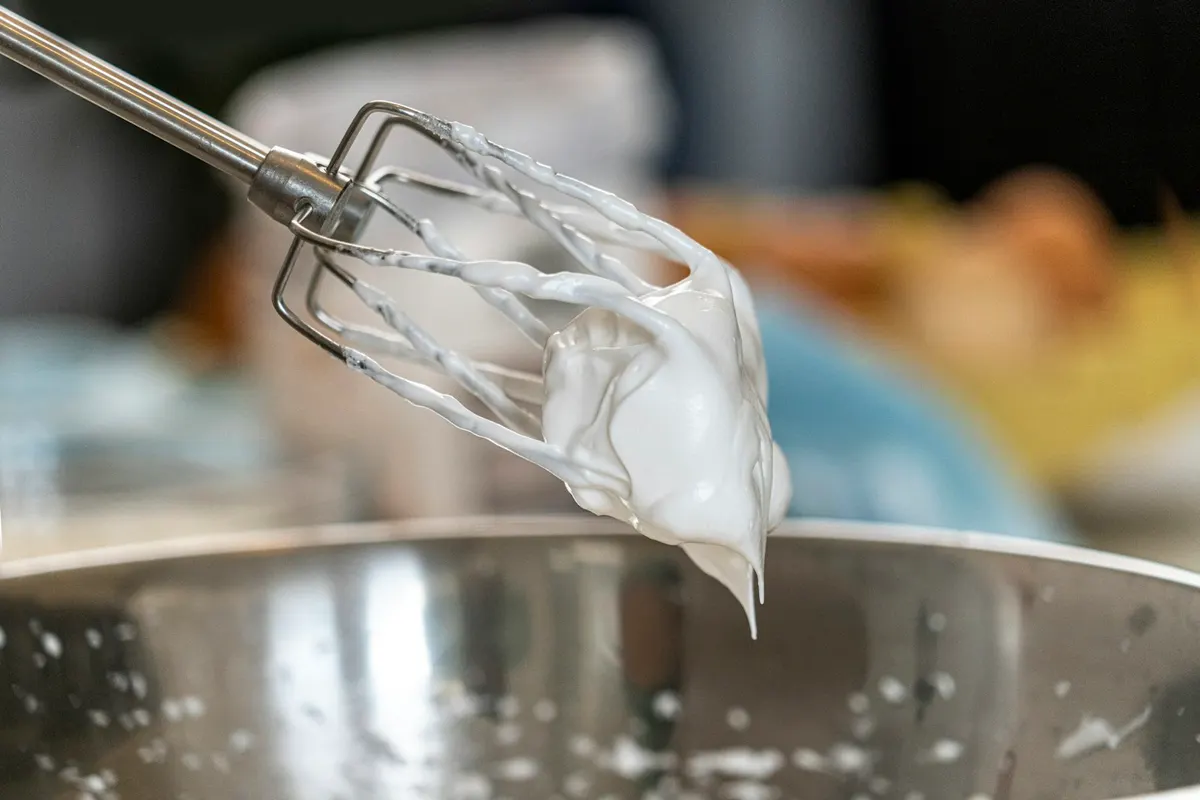
Chill a tin of full-fat coconut milk overnight without shaking it, spoon off only the solid white layer, and whip that with a chilled bowl and beaters for two to three minutes until it holds soft peaks. Sweeten at the end. It is the one substitute that genuinely whips, and it tastes of coconut.
That is the short answer. The details are where it goes wrong.
Overnight, not an hour. The tin has to be cold enough for the fat to set solid and separate cleanly from the water. A few hours in the fridge gives you a slushy layer that never stiffens. The back of the fridge is better than the door.
Do not shake the tin, and open it the right way up. You are trying to keep the two layers apart. Shaking remixes them and there is no way back short of chilling it again overnight.
Spoon the solid, leave the water. The thin liquid underneath is what stops it holding. Keep it for a curry or a smoothie rather than tipping it in. If you have scooped up too much and the mixture stays loose after three minutes, it is usually this rather than the whipping.
Chill the bowl and the beaters too. Warm equipment softens the fat as fast as you are aerating it. Ten minutes in the freezer is enough.
Sweeten last, and use icing sugar rather than granulated. Sugar added early weighs the foam down, and the cornflour in icing sugar helps it hold.
Not every brand works. Coconut milk sold with added emulsifiers often will not separate at all, so if a tin refuses twice, it is the tin. Look for one whose ingredients are coconut and water.
Full-fat crème fraîche, the other one that works
It whips, and it whips fast, to something dense and tangy rather than light and sweet. Good on a fruit tart or beside something rich. Wrong for a birthday cake.
Watch it more closely than cream, because the same fat that lets it whip lets it turn to butter, and the window is short.
Evaporated milk is the one people ask about
Chilled hard, evaporated milk will froth up. Its proteins trap air even though its fat cannot hold it, so what you get is a foam rather than whipped cream. It is thin, it tastes faintly caramelised, and it deflates within a few minutes.
The alternatives table on this page says evaporated milk will not whip, and that is the sense meant. It will make a foam. It will not make whipped cream.
When to stop trying and buy the cream
If it has to hold for more than about twenty minutes, if it has to be neutral in flavour, or if it is going on top of a cake in front of people, buy the cream. Whipped coconut cream is a real thing worth making on its own terms. It is not a copy of whipped cream, and every guide that says it is has not put the two side by side.
If a recipe calls for double cream instead
UK double cream is about 48 percent fat. US heavy cream is about 36 percent. They are not the same product, and treating them as interchangeable changes the result.
The actual UK equivalent of American heavy cream is whipping cream, about 35 percent fat. That is what to buy in a British supermarket when a US recipe says heavy cream. UK single cream, about 18 percent fat, is roughly the US light cream, and it will not whip.
| UK cream | Fat | Closest US equivalent |
|---|---|---|
| Double cream | about 48% | none exactly, richer than heavy cream |
| Whipping cream | about 35% | heavy cream |
| Single cream | about 18% | light cream |
Use heavy cream where a recipe wants double cream and you get something thinner and less rich, holding less stiffly when whipped. Go the other way and double cream whips much faster than heavy cream, so it turns to butter sooner than you expect: stop earlier than you think. Because double cream is richer to start with, every substitute on this page sits further from it than from heavy cream. The swaps still work, but the gap is bigger and the result noticeably lighter.
Can you use crème fraîche instead of heavy cream?
Yes, in anything you cook. No, if it has to whip into soft peaks, and not before you have looked at which crème fraîche you picked up, because that choice moves the fat further than the swap itself does.
Check the tub, not the word. Crème fraîche is sold at very different fat levels and the label rarely leads with it. The light version is the one this page recommends and the one the calculator above is built on. Full-fat crème fraîche is a rich product, closer to cream than to yogurt, and swapping it into a recipe will not save you anything. Most guides say “crème fraîche is a good substitute for heavy cream” and stop there, which is how people end up adding fat while believing they cut it.
In a hot pan it is the best option on this page, light or full fat. It is cultured and stable, so it does not split when the sauce boils, which is the single failure that ruins the lighter swaps. The pasta and hot sauces section above has the ratio.
It does change the taste, and nobody says so plainly. Crème fraîche is cultured, so it carries a mild sourness that heavy cream does not. In a mushroom sauce, a stroganoff or anything with lemon in it, that tang is an improvement. In a sweet custard or a panna cotta it is not, and you will notice.
Whipping is the one real limit. Full-fat crème fraîche will whip, though to something tangy and dense rather than the neutral soft peaks you were probably after. The light version will not, for the fat reason in the thing to decide first. If the recipe needs it whipped and sweet, buy the cream.
What is the US equivalent of crème fraîche?
There is not an exact one, which is worth saying rather than pretending otherwise. Crème fraîche does not even appear in the USDA’s standard reference food database, and that absence is a fair signal of how far it sits outside a normal American shop.
The usual stand-in is sour cream, and it is close in flavour but not in behaviour: sour cream has less fat and splits when it boils, so it works stirred in off the heat and fails in a simmering pan. Mexican crema is nearer still and is easier to find in most of the US. If a recipe leans on the fact that crème fraîche survives heat, sour cream is not a safe swap for it.
Going the other way, if you are in the UK reading an American recipe, crème fraîche is stocked everywhere and the substitution question rarely comes up.
For pasta and hot sauces
Light crème fraîche, 1:1. It has enough fat to stay smooth in a simmering pan, which is exactly where cheaper substitutes fail.
Milk and melted butter also works here and is what most people have to hand. Whisk a quarter cup of melted butter into three quarters of a cup of whole milk. Let the butter cool a little first, because pouring hot butter into cold milk sets it into flecks that never fully disperse.
Greek yogurt loosened with milk is the lightest option, but it must go in off the heat. If the sauce boils afterwards, it will split.
For soup
Same rules, one addition: you can often skip the substitute entirely. A ladle of the soup blended and stirred back in thickens it without any dairy at all, which is how a lot of restaurant vegetable soups get their body.
For baking
Evaporated milk is the strongest choice and the most overlooked. It is milk with about 60 percent of the water removed, so it behaves richly in a bake, and it is shelf-stable, which means it is often already in the cupboard. It carries a faintly caramelised flavour that suits custards and bakes and is less welcome in something delicate.
Milk and butter works too. Buttermilk does not, because it is far more acidic and will change how the raising agents behave.
For frosting
Buy the cream. Frosting needs whipping, and this is the one job where substitutes genuinely do not work. Coconut cream will whip but tastes of coconut, which is either a feature or a problem depending on the cake.
On the Thanksgiving table
Four jobs, and the substitutes only fail at one of them.
Mashed potatoes. Milk and melted butter, the standard swap, is arguably better here than cream, because you were adding butter to the potatoes anyway. The one thing that matters is temperature: warm the milk first. Cold dairy into hot potatoes drops the temperature of the whole bowl and you spend the next ten minutes reheating something that should have gone straight to the table. The full method, including why a food processor ruins mash, is on our lighter mashed potatoes.
Gravy. Cream is a finishing splash rather than a base, so almost anything works, with one exception worth knowing. Add it off the heat, or use light crème fraîche, which is the one dairy on this page that will not split in a hot pan. Greek yogurt loosened with milk will split if the gravy is still bubbling, and once it has split you cannot bring it back. If the gravy needs thickening rather than enriching, that is a different job and the ratios are on how much cornstarch to thicken.
Pumpkin pie. Do not substitute here on autopilot. The filling is a custard that sets on egg protein and cream fat, and thinning the fat gives you a filling that weeps. The useful thing to know is that evaporated milk is not really a substitute in this recipe at all: the classic American pumpkin pie is built on evaporated milk in the first place, so using it is going back to the original rather than compromising.
The whipped cream on top. Buy the cream. This is the one job on the table where every substitute except chilled coconut cream genuinely fails, for the reason in the section above: whipping needs roughly 30 percent fat to hold air. A quarter pint of double cream is a small price for the one component everybody notices.
Making it ahead. Light crème fraîche and evaporated milk both reheat without splitting, which matters on a day when everything is made in advance and warmed through. Yogurt-based swaps do not, so use those in something served cold or not at all.
What the swap costs you
Heavy cream is around 36 percent fat. Light crème fraîche is closer to 15 percent, so swapping one for the other in a dish serving four is worth roughly 8 g less fat and about 60 fewer calories per serving, with protein and carbs barely moving.
Those are estimates, worked out from typical ingredient values rather than measured, and they shift with the brand. The direction holds even when the exact figure does not.
Milk and butter is not a lighter option, despite feeling like one. You are reassembling cream from its parts, so the fat lands in roughly the same place. It is a convenience swap, not a health one, and it is worth being clear about that because a lot of pages imply otherwise.
Common questions
Whisk three quarters of a cup of whole milk into a quarter cup of melted butter and use it 1:1. That covers soups, sauces and most baking. For a hot pan sauce, light crème fraîche is more reliable because it will not split. Neither option will whip.
For thin sauces and some baking, yes, though the result is noticeably less rich because milk is around 3 percent fat against roughly 36 percent for heavy cream. Add melted butter to close the gap, or whisk in cornstarch if you only need body rather than richness.
Whipping needs roughly 30 percent fat to hold air, so milk-and-butter mixes, evaporated milk, yogurt, light crème fraîche and cornstarch blends all fall well short. Two options do work. Chilled coconut cream whips, and so does full-fat crème fraîche, though to something tangy and dense rather than neutral soft peaks. If you want sweet whipped cream, buy the cream.
Melt a quarter cup of butter, let it cool slightly, then whisk it slowly into three quarters of a cup of whole milk. Adding hot butter to cold milk makes it seize into flecks, so let both come towards room temperature first.
Milk thickened with cornstarch, which has almost no added fat. Light crème fraîche is the best compromise if you want something that still behaves like cream in a hot pan, and it is the swap ReciPop applies when your goal is less fat.