Evaporated milk substitutes, and the one that tastes the same
Simmer about 3 1/3 cups of whole milk down to 1 1/2 cups to replace one can. What works in pumpkin pie, mac and cheese and dairy-free, compared on macros.
How they compare, per 100 g
Most substitute guides tell you what works and stop there. If you are choosing partly on macros, here are the numbers side by side.
Evaporated milk carries under 8 g of fat per 100 g. Half and half is about half as much again, tinned coconut milk nearly three times as much and heavy cream nearly five times, while the powdered milk mix carries almost none.
| Per 100 g | kcal | Protein | Carbs | Fat |
|---|---|---|---|---|
| Evaporated milk | 135 | 6.8 g | 10 g | 7.6 g |
| Whole milk, simmered down | 137 | 7.6 g | 10.8 g | 7.2 g |
| Half and half | 131 | 3.1 g | 4.3 g | 11.5 g |
| Powdered milk, double strength | 91 | 9.1 g | 13 g | 0.2 g |
| Heavy cream | 340 | 2.1 g | 2.8 g | 36 g |
| Coconut milk, tinned | 197 | 2 g | 3 g | 21 g |
| Soy milk, simmered down | 74 | 6.5 g | 2.7 g | 4 g |
| Sweetened condensed milk | 321 | 7.9 g | 54 g | 8.7 g |
Typical values, rounded. Brands vary, so treat these as estimates for comparing options rather than exact figures.
Every option, and when to use it
Which one works depends on what the ingredient is doing in the recipe, so here is the full list, with where each one fails.
| Use | How much | Best for |
|---|---|---|
| Whole milk, simmered down | about 3 1/3 cups reduced to 1 1/2 cups replaces one 12 fl oz can | pumpkin pie, fudge, and anything that should taste exactly as written Watch out: takes at least half an hour, and scorches on the bottom if you walk away |
| Half and half | 1:1 | soups, chowders, mac and cheese, and a quick pie Watch out: about half as much fat again, and a custard sets slightly softer |
| Powdered milk, double strength | 100 g instant nonfat dry milk whisked into 300 ml water replaces one can | baking, emergencies, and the lightest result Watch out: almost no fat, so a pie or sauce comes out leaner and less rich |
| Heavy cream | 1:1, or half cream and half whole milk | rich sauces and queso Watch out: nearly five times the fat of evaporated milk |
| Full fat coconut milk, tinned | 1:1 | dairy-free pumpkin pie and curries Watch out: tastes of coconut, and carries almost three times the fat |
| Unsweetened soy milk, simmered down | reduce by the same amount as dairy milk | dairy-free cooking where coconut would be wrong Watch out: must be unsweetened, and oat or almond milk reduce thinner |
| Lactose-free milk, simmered down | reduce by the same amount as whole milk | anyone avoiding lactose who still wants the dairy flavour Watch out: tastes a little sweeter, because its lactose has been split into simpler sugars |
| Regular milk, straight | 1:1 | only where evaporated milk is just the liquid, such as coffee or a loose sauce Watch out: half the milk solids of evaporated milk, so a pie filling or fudge sets soft or not at all |
To replace one 12 fl oz can of evaporated milk, simmer about 3 1/3 cups of whole milk down to 1 1/2 cups. It is the only substitute that tastes the same, because it is the same thing made at home. In a hurry, half and half works 1:1 in almost anything, and it only really shows in a custard or fudge.
Everything below is about which substitute to use for which dish, and the one swap people reach for that does not work.
What evaporated milk actually is
Milk with more than half its water removed, and nothing added. That is not a description, it is the legal definition: under US federal regulations, evaporated milk is made by “partial removal of water only from milk”, and must contain at least 6.5% milkfat and at least 23% total milk solids (21 CFR 131.130).
That definition is the whole substitution guide in one line. Anything that puts the water back, like plain milk, fails where the concentration matters. Anything that adds sugar, like sweetened condensed milk, is a different ingredient altogether.
Which one for which job
| You are making | Use | Why |
|---|---|---|
| Pumpkin pie | Whole milk simmered down, or half and half | The filling needs the concentration to set |
| Fudge and caramel | Whole milk simmered down | Extra water stops them setting |
| Mac and cheese, queso | Half and half | It is richer, and the sauce does not need to set |
| Soups and chowders | Half and half, or regular milk | Nothing here depends on concentration |
| Coffee | Regular milk or half and half | It is only there for creaminess |
| Dairy free | Tinned coconut milk, or soy milk simmered down | Coconut for pie and curry, soy where coconut would clash |
| The lightest option | Powdered milk, double strength | Almost no fat |
Can you use regular milk instead of evaporated milk?
In some recipes, yes. In the ones that most often call for evaporated milk, no.
Where evaporated milk is simply the liquid, in coffee, a soup or a loose sauce, regular milk 1:1 is fine and you will not taste much difference. Where it is there for concentration, in pumpkin pie, fudge, caramel or a baked custard, plain milk brings less than half the milk solids the recipe was built around, and the result sets soft, weeps or never sets.
The fix is to take the water out yourself.
How much milk equals a can of evaporated milk?
A standard can holds 12 fl oz, which is 1 1/2 cups. Simmer about 3 1/3 cups of whole milk until it reduces to 1 1/2 cups. For a small 5 fl oz can, reduce about 1 1/3 cups of milk to just over half a cup.
Every substitute, per can
| Substitute | For a US can, 12 fl oz | For a UK tin, 410 g |
|---|---|---|
| Whole milk, simmered down | 3 1/3 cups, reduced to 1 1/2 cups | 850 ml, reduced to 385 ml |
| Half and half | 1 1/2 cups | 385 ml, or equal parts single cream and whole milk |
| Powdered milk, double strength | 100 g in 300 ml of water | 110 g in 325 ml of water |
| Full fat coconut milk, tinned | 1 1/2 cups | 385 ml, most of a 400 ml tin |
| Unsweetened soy or lactose-free milk, simmered down | 3 1/3 cups, reduced to 1 1/2 cups | 850 ml, reduced to 385 ml |
A British tin holds a little more than an American can: 410 g of evaporated milk is about 385 ml, at USDA’s weight of 252 g a cup (FoodData Central, SR Legacy 171276). For the small cans, 5 fl oz in the US or 170 g in the UK, use about two fifths of any amount in the table.
Use a wide pan, which reduces faster than a deep one, and keep the milk at a gentle simmer rather than a boil. Stir every few minutes and scrape the bottom. Expect it to take at least half an hour. Milk scorches where it touches the pan, and a scorched batch tastes of it all the way through.
Measure it rather than guessing by eye. Pour it into a measuring jug partway through. It always looks further along than it is.
Skimmed milk reduces the same way and gives a lighter result, but a pie made with it is noticeably less rich.
In pumpkin pie
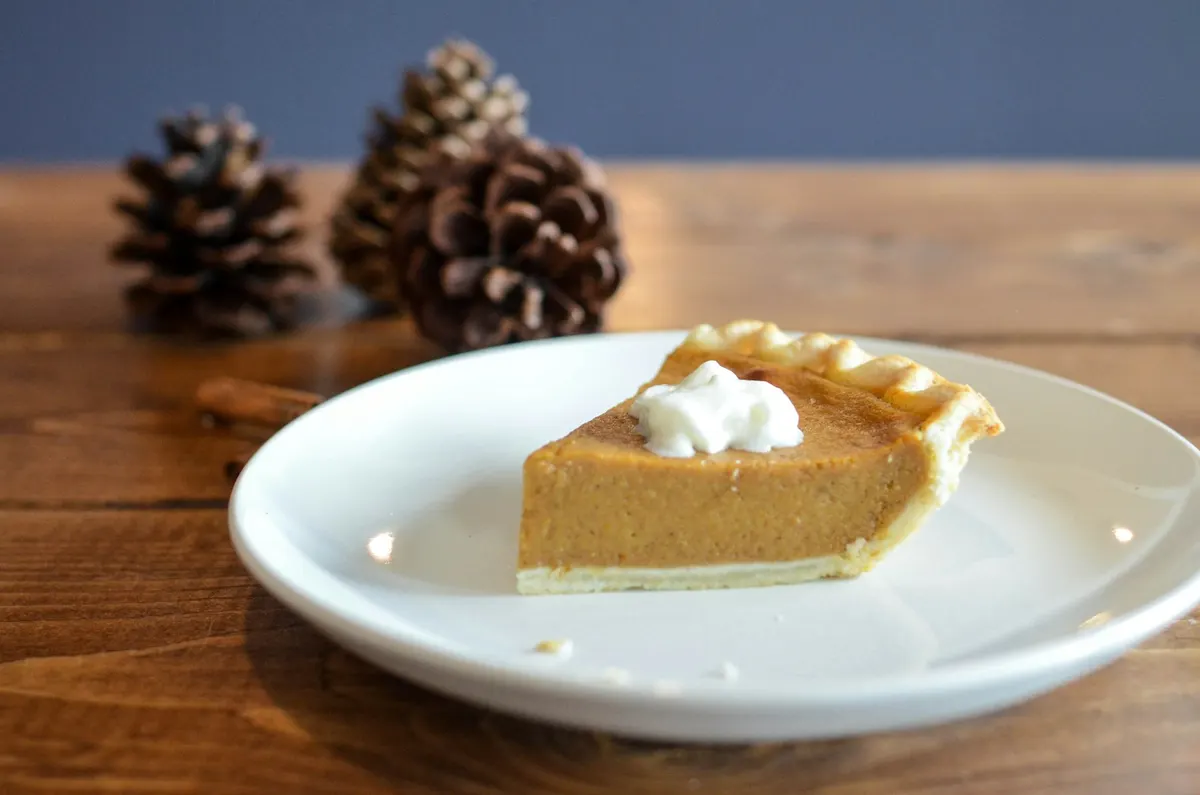
This is the dish most people are searching about, usually in November, with the tin already missing from the cupboard.
Best result: whole milk simmered down. It is evaporated milk made at home, so the pie comes out as the recipe intended. Let it cool before it goes into the filling, or the warm milk starts cooking the eggs.
Quickest: half and half, 1:1. The filling sets slightly softer because half and half carries more water, so give the pie its full baking time and check that the centre only wobbles slightly before it comes out.
Dairy free: tinned full fat coconut milk, 1:1. The spices in a pumpkin pie cover most of the coconut flavour. It will not be invisible, and it carries almost three times the fat.
In mac and cheese and queso
Evaporated milk earns its place in cheese sauces because it is concentrated milk protein without much water, and that helps keep melted cheese smooth rather than greasy. Half and half 1:1 is the simplest swap.
If the sauce splits, the problem is heat rather than the substitute. Take the pan off the heat before the cheese goes in. Tossing the grated cheese with a teaspoon of cornstarch first, which British shops sell as cornflour, gives the sauce extra insurance. More on cornstarch.
Sweetened condensed milk is not a substitute
It sits next to evaporated milk on the shelf and the tins look alike, which is how it ends up in the wrong recipe. It is concentrated milk with a large amount of sugar added: the same federal regulations define it as milk with water removed and “nutritive carbohydrate sweeteners” added, at not less than 28% total milk solids (21 CFR 131.120).
The macro table at the top of this page shows the difference: roughly 54 g of carbohydrate per 100 g, against 10 g for evaporated milk. In anything savoury it is simply wrong. In a dessert it will make the result far sweeter and thicker than written, so it is only worth trying in a recipe you are prepared to adjust.
The other way round does work, with sugar added: see sweetened condensed milk substitutes.
Dairy free
Tinned full fat coconut milk for pumpkin pie, curries and anything with enough spice to carry it. Use the tin, not the carton, which is a drink and far too thin.
Unsweetened soy milk, simmered down by the same amount as dairy milk, where coconut would clash. Soy has enough protein to reduce to a useful thickness. Oat and almond milk carry much less, so they reduce thinner and give a looser result.
Lactose-free evaporated milk
Lactose-free milk is still cow’s milk, with an enzyme added that splits the lactose into simpler sugars, so it simmers down exactly like whole milk and replaces a can the same way. It tastes slightly sweeter, which a pumpkin pie hides and a savoury sauce may not. It is not dairy free: for that, use the coconut or soy milk above.
Using evaporated milk in place of regular milk
The other direction works well. Mix evaporated milk 1:1 with water and you are back to something slightly richer than whole milk, by our estimate about 68 kcal per 100 g against 61. It is a useful thing to keep in a cupboard for exactly that reason.
Half and half, if you are shopping in Britain
UK supermarkets rarely sell half and half, and it is not the same as single cream. US regulations define half and half as between 10.5% and 18% milkfat (21 CFR 131.180), and British single cream is typically around 18%, at the top of that range.
Equal parts single cream and whole milk comes to around 10 to 11% fat, which is half and half in all but name. Evaporated milk itself is sold in British shops under the same name, so the milk method above works unchanged.
For every way to replace half and half itself, including the mixes that land inside its fat range, see half and half substitutes.
What the swap does to the macros
Whole milk simmered down matches evaporated milk almost exactly, which is the point. Half and half is similar on calories but carries more fat and less than half the protein. Heavy cream is the one that changes a dish: at 36% fat, the legal minimum for heavy cream in the US (21 CFR 131.150), it has nearly five times the fat of the evaporated milk it replaces.
The powdered milk mix is the lightest by a distance, with the most protein per calorie and almost no fat, and it is also the one that makes a pie taste least like the original.
Macro figures are estimates per 100 g from typical ingredient values, not measurements, and the simmered-down figures assume milk reduced to a little under half its volume.
Dishes to make next
- High protein mac and cheese that is still just mac and cheeseA mac and cheese that needs no evaporated milk: whole milk and a roux, with the cheddar stirred in off the heat.
Common questions
Half and half, used 1:1, is the quickest swap and works in soups, sauces and most bakes. For a result that tastes exactly like the original, simmer about 3 1/3 cups of whole milk down to 1 1/2 cups, which replaces one 12 fl oz can. For something lighter, whisk 100 g of instant nonfat dry milk into 300 ml of water.
Only after reducing it, or in recipes where evaporated milk is just the liquid. Evaporated milk is milk with more than half its water taken out, so plain milk poured in at 1:1 brings less than half the milk solids a pumpkin pie or fudge was built around, and it sets soft or not at all. In coffee or a loose sauce, plain milk is fine.
Simmer whole milk until it has lost more than half its volume: about 3 1/3 cups down to 1 1/2 cups for a US 12 fl oz can, or about 850 ml down to 385 ml for a UK 410 g tin. Keep it below a boil, stir often and scrape the bottom, and expect it to take at least half an hour. For a version with no cooking, whisk 100 g of instant nonfat dry milk into 300 ml of water.
About 3 1/3 cups of whole milk, simmered gently until it reduces to 1 1/2 cups, which is the volume of a standard 12 fl oz can. For a small 5 fl oz can, reduce about 1 1/3 cups of milk to just over half a cup. Stir often and keep it below a boil, or the milk catches on the bottom of the pan.