Cottage cheese lasagna, with the ricotta question answered
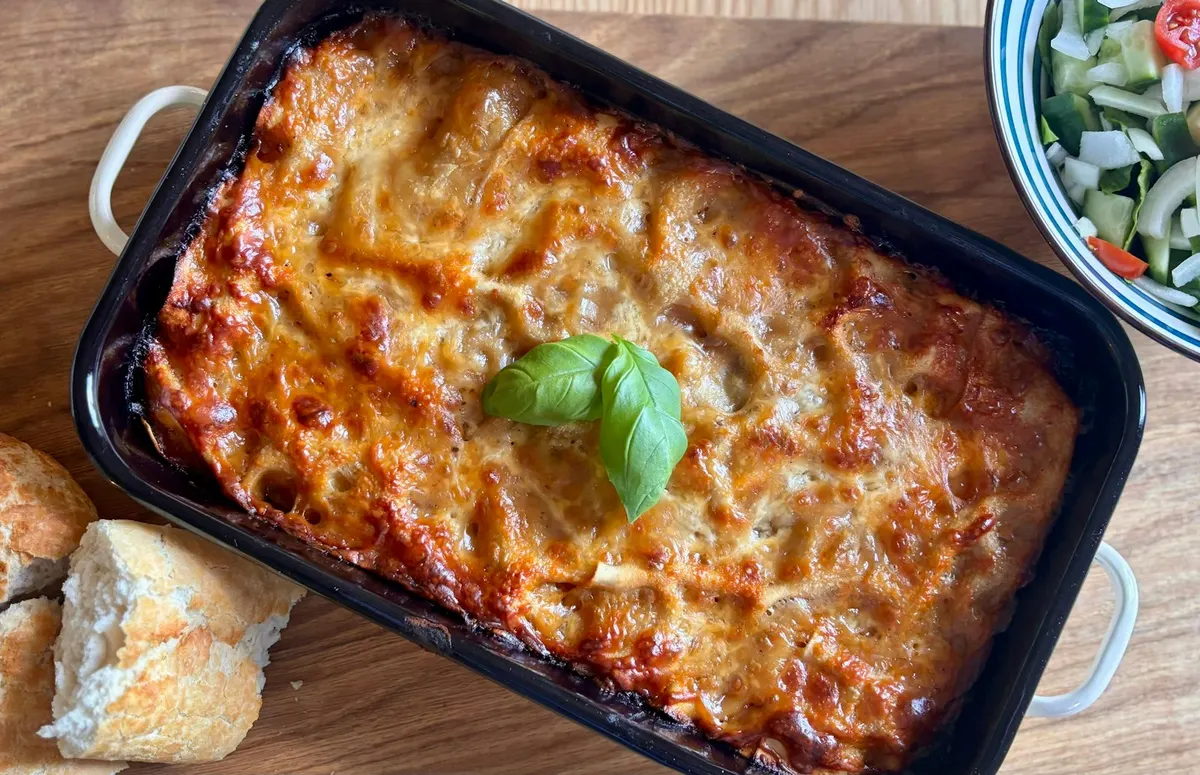
Cottage cheese replaces ricotta in lasagna 1:1, with more protein and under half the fat. A slice here is about 521 calories and 36 g of protein by our estimate.
Adjust this recipe
Ingredients
- 480 g ground beef (beef mince), 80/20
- 160 g onion, finely chopped
- 4 garlic cloves, crushed
- 2 tsp dried oregano
- 40 g tomato purée, tomato paste in the US
- 800 g passata, or canned tomato sauce in the US
- 240 g lasagna noodles, dried, the no-boil kind, lasagne sheets in the UK
- 680 g full-fat cottage cheese, 4% milkfat
- 2 eggs
- 224 g low-moisture mozzarella, part-skim, grated
- 48 g parmesan, finely grated
- 16 g fresh parsley, chopped
Method
- Tip the cottage cheese into a sieve set over a bowl and leave it to drain while you make the sauce. Heat the oven to 190C (170C fan, 375F).
- Brown the beef in a large dry frying pan over a medium-high heat in two batches, breaking it up, then leaving it alone for a minute at a time so it colours rather than steams. Lift each batch out with a slotted spoon, then pour off all but a spoonful of the fat.
- Turn the heat down, add the onion to the pan and soften it for 6 to 8 minutes. Stir in the garlic and oregano for 30 seconds, then the tomato purée for a minute, until it darkens a shade.
- Put the beef back with the passata, then rinse the jar or can with a little water and add that too. Simmer uncovered for 10 to 15 minutes and stop while the sauce is still a little looser than one you would serve on spaghetti, because the noodles cook in that liquid. Season it lightly.
- Blend the drained cottage cheese until smooth, or leave it as it is if you do not mind seeing the curds. Mix in the eggs, half the mozzarella, half the parmesan, the parsley and plenty of black pepper. Leave the salt out: the cottage cheese and parmesan bring enough.
- Spread a quarter of the sauce over the base of a baking dish about 23 by 33 cm (9 by 13 inch). Lay a third of the noodles on top with small gaps between them, because they swell as they cook, then spread over half the cheese mixture and another quarter of the sauce. Repeat with another third of the noodles, the rest of the cheese mixture and another quarter of the sauce. Noodles that are not the no-boil kind need boiling first, 2 minutes short of the packet time.
- Lay on the last of the noodles and cover them with the rest of the sauce, pushing it right into the corners so no pasta is left bare. Scatter over the remaining mozzarella and parmesan.
- Cover the dish tightly with foil, tented so it does not touch the cheese, and bake for 30 minutes. Uncover and bake for another 15 to 20 minutes, until the top is browned in patches, the sauce bubbles at the edges and a knife slides through the middle without meeting any resistance from the pasta.
- Leave it to stand for 15 minutes before cutting it into eight. Cut it straight from the oven and the cheese layer runs. Give it the time and it sets.
Cottage cheese replaces ricotta in lasagna 1:1. Drained and mixed with egg and parmesan, it bakes into a layer that sets and slices the way ricotta does. It is also the lighter cheese and the higher-protein one: against whole-milk ricotta it takes 5 to 6 g of fat off each slice and adds 2 to 4 g of protein.
The recipe above makes eight slices from a 23 by 33 cm (9 by 13 inch) dish, at about 521 calories and 36 g of protein each by our estimate. The rest of this page is the ricotta comparison in numbers, the egg question, and what makes a cottage cheese lasagna go watery.
Can you use cottage cheese instead of ricotta in lasagna?
Yes, 1:1, and it comes out ahead on every macro. Here is one slice of the lasagna above made five ways, at 85 g of cheese a slice.
| The cheese layer | kcal | Protein | Fat |
|---|---|---|---|
| Full-fat cottage cheese, as written | 521 | 36 g | 25 g |
| Whole-milk ricotta, USDA figures | 565 | 33 g | 30 g |
| Whole-milk ricotta, median of six US labels | 571 | 34 g | 31 g |
| Galbani whole-milk ricotta, from its label | 574 | 32 g | 31 g |
| Half cottage cheese, half ricotta, USDA figures | 543 | 35 g | 27 g |
USDA’s current entry for whole-milk ricotta gives 7.5 g of protein per 100 g, against 11.1 g for full-fat cottage cheese (FoodData Central, SR Legacy 170851 and 172179). Older versions of the same table gave ricotta 11.3 g, and that figure is still repeated on nutrition sites, so you will see the two cheeses described as equal on protein. On current figures they are not.
The labels tell the same story. Across 16 US brands of full-fat cottage cheese on Open Food Facts, the median is 10.6 g of protein per 100 g. Across six brands of whole-milk ricotta it is 9 g, and Galbani’s label gives 4 g per quarter cup, about 6.5 g per 100 g. On fat, cottage cheese has less than half of ricotta’s whichever source you use.
If you like ricotta’s softer, milkier layer, half of each is a fair compromise, and the row above shows what it costs.
Brand figures were checked on 18 September 2026, with each brand’s products reduced to one median first so a brand sold in five sizes does not count five times. Contains information from Open Food Facts, available under the Open Database License.
Do you put an egg in cottage cheese for lasagna?
Yes. The egg is what turns the cheese into a layer rather than a spread: it sets in the oven and holds the curds together, so a slice keeps its shape instead of slumping onto the plate. Two eggs set the whole dish, which is a quarter of an egg a slice, about 18 calories and 1.6 g of protein.
Without egg the layer still bakes, just softer, and it weeps a little when you cut it. If you are leaving it out, drain the cottage cheese for longer and add a little more parmesan to help it hold.
Should you blend the cottage cheese?
Only if you mind the curds. Unblended, they stay as small soft lumps through the bake and show in the cut face of a slice, which is a matter of taste. Blended for a minute, the layer is smooth and reads as ricotta. Either way, drain it first, because any liquid you blend back in comes out again in the oven.
What to mix with cottage cheese for lasagna
The egg, for the set. Parmesan, for flavour and to take up some of the moisture. Half the mozzarella, so the layer has some stretch. Parsley and black pepper. A pinch of nutmeg suits it too, as it suits most soft cheese fillings.
What it does not need is salt. By USDA’s figures, full-fat cottage cheese carries nearly three times the sodium of whole-milk ricotta, 315 mg per 100 g against 110 mg, and the parmesan brings more on top.
Where the protein in a slice comes from
One slice is an eighth of the dish.
| Part of the slice | kcal | Protein | Carbs | Fat |
|---|---|---|---|---|
| Beef mince, 60 g | 146 | 11 g | 0 g | 12 g |
| Lasagna noodles, 30 g dried | 111 | 4 g | 22 g | 0 g |
| Mozzarella, 28 g | 84 | 7 g | 1 g | 6 g |
| Cottage cheese, 85 g | 83 | 9 g | 3 g | 4 g |
| Tomato sauce, onion and garlic | 53 | 2 g | 13 g | 0 g |
| Egg, parmesan and parsley | 44 | 3 g | 1 g | 3 g |
| Per slice | 521 | 36 g | 40 g | 25 g |
About half the protein, 19 g, comes from the cheeses and the egg. The beef brings 11 g and nearly half the fat, which is why swapping it moves the fat and leaves the protein where it was. The pasta carries only 4 g, so chickpea noodles do less here than on a plate of spaghetti, which holds nearly three times as much pasta.
The two swaps, and what each is worth
| Swap | kcal | Protein | Carbs | Fat | Running total |
|---|---|---|---|---|---|
| Beef to 93% lean turkey | −54 | 0 g | 0 g | −6 g | 467 kcal, 36 g protein |
| Noodles to chickpea noodles | +1 | +3 g | −4 g | +1 g | 468 kcal, 39 g protein |
Turkey is a fat swap. Per 100 g raw, 93 percent lean turkey and 80/20 beef carry almost the same protein by USDA figures, 17.3 g against 17.5 g, and the turkey has half the fat. It gives up less fat in the pan, so there will be little or nothing to pour off. The turkey bolognese covers how to brown it so it does not turn grey.
Chickpea noodles add protein, not lightness. The figures come from Chickapea’s label, 13 g of protein per 56 g serving against about 7 g for wheat noodles by USDA values, at almost the same calories. They are also harder to find than chickpea spaghetti. On 18 September 2026 Chickapea’s own shop showed its lasagna sold out and Banza’s shop no longer listed one, though both still appeared on supermarket sites. Buy them when you see them rather than planning a dinner around them.
If it is carbohydrate you want to cut, zucchini, courgette in Britain, is the bigger lever. About 120 g of it a slice in place of the noodles takes roughly 19 g of carbohydrate and 2 g of protein off each slice. It also turns the dish wetter unless you salt and roast the slices first, so treat it as a different lasagna rather than a swap.
What goes wrong
A watery lasagna. Cottage cheese holds more water than ricotta, about 80 percent of its weight against 74 percent by USDA figures, and the oven drives it out. Drain it while the sauce cooks, simmer the sauce until it is only a little looser than a spaghetti sauce rather than soupy, and let the dish stand before you cut it. Lower-fat cottage cheese is wetter still, 81 to 83 percent water, so drain it for longer. It is a fair trade if you want it: 1% milkfat saves about 3 g of fat a slice and adds a little protein.
Hard edges. No-boil noodles cook in the liquid around them, and any corner left above the sauce bakes into something closer to a cracker. Push the top layer of sauce into the corners and keep the foil on for the first 30 minutes.
A slice that slumps. Straight from the oven the cheese layer is still loose, and it firms up as it cools. Fifteen minutes is enough. The egg is the other half of this.
Too salty. Season the sauce lightly and the cheese mixture not at all, then taste a corner of the finished dish before you reach for the salt.
Vegetarian cottage cheese lasagna
Replace the beef with 100 g of mushrooms and 40 g of spinach a slice, 800 g and 320 g for the dish. Cook the sliced mushrooms and the onion in a teaspoon of oil until the mushrooms have given up their water and started to brown, then carry on with the garlic. Wilt the spinach, squeeze it hard and stir it into the cheese mixture. A slice comes to about 411 calories, 30 g of protein and 14 g of fat by our estimate.
Parmesan made the traditional way uses animal rennet, so a strictly vegetarian version needs a vegetarian hard cheese in its place.
Is cottage cheese lasagna healthy?
It is lasagna, and a slice is a full dinner. What cottage cheese changes is the arithmetic: about 521 calories and 36 g of protein a slice as written, about 468 and 39 g with both swaps, against 565 to 574 calories with ricotta in the same dish. The biggest lever is the one no recipe card mentions. These numbers assume an eighth of the dish, and cutting it in six makes every slice a third bigger.
On a weeknight, the lasagna soup gets the same flavours into a bowl in 45 minutes, at about 479 calories and 30 g of protein.
Lasagne with cottage cheese instead of white sauce
In Britain, lasagne is more often layered with a white sauce, béchamel, than with ricotta. The cottage cheese layer takes the same place in the stack, and weight for weight it carries about three times the protein of a béchamel made with whole milk, butter and flour, with about half the fat, by USDA values. Beef mince, passata and lasagne sheets are the British names for the ingredient lines above.
Making it ahead, storing and freezing
Assemble it up to a day ahead, cover it and keep it in the fridge, then add 10 to 15 minutes to the covered bake, because it goes in cold. Leftovers keep 3 to 4 days in the fridge and 3 to 4 months in the freezer, the USDA guidance for leftovers. Reheat a slice covered until it is hot in the middle, 74C (165F). The cheese layer can loosen a little after freezing, which the sauce mostly hides.
Every figure on this page is an estimate from typical ingredient values and product labels, not a measurement. Why recipe macros are estimates explains how far they move with the brands you buy.
Where next
This recipe is one of the dishes in High protein meal prep: one Sunday, five days, about 100 g of protein a day.
Worth cooking next:
- Turkey bolognese, and what the turkey actually saves youTurkey mince is a fat swap, not a protein one. A plate here is about 723 calories and 41 g of protein by our estimate, against 835 with standard beef mince.
- Cottage cheese pasta sauce, blended properlyA creamy pasta sauce from cottage cheese at 29 g protein a plate. Why it splits in a hot pan, how to stop it, and the blending step nobody skips twice.
- High protein mac and cheese that is still just mac and cheeseClassic stovetop mac and cheese already carries about 31 g of protein a bowl, from the cheddar and the pasta. What chickpea pasta, cottage cheese and chicken add.
Cooking it as part of a week? ReciPop plans seven days of meals around the time you have, the appliances you own and how many you are feeding, then turns them into one grocery list sorted by aisle. How the weekly plan works