Low carb pad thai, and an honest word about the noodles
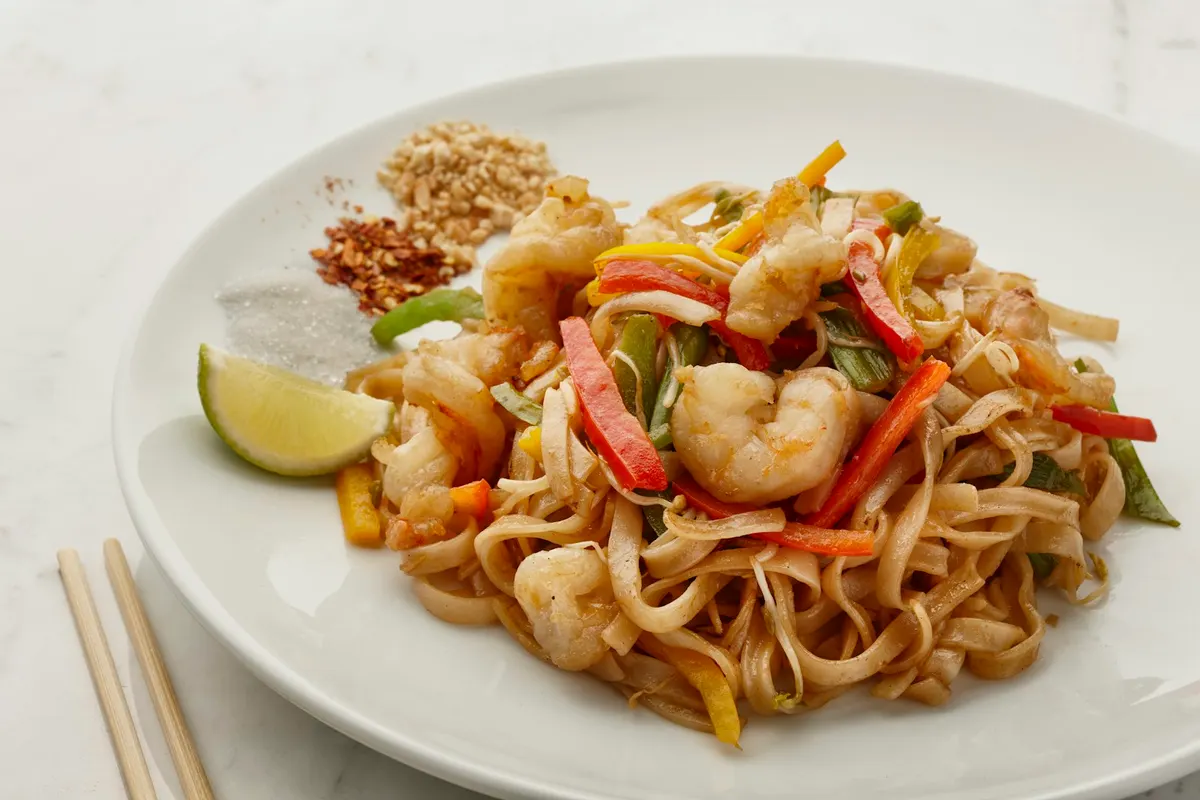
Pad thai with half the rice noodles and a pile of beansprouts, at 46 g protein a serving. The keto versions reach 2 g of carbs, and this says what that costs.
Adjust this recipe
Ingredients
- 300 g raw prawns, peeled, or diced chicken breast
- 80 g flat rice noodles, dried, half a normal portion
- 200 g beansprouts, this is what replaces the other half
- 2 whole egg, beaten
- 80 g Chinese chives or spring onion, cut into 4 cm lengths
- 3 tbsp fish sauce
- 2 tbsp tamarind paste
- 2 tsp palm sugar or light brown sugar
- 2 tsp neutral oil
- 20 g roasted peanuts, roughly crushed, to finish
- 1 whole lime, to squeeze over at the table
Method
- Soak the rice noodles in hot tap water for about 20 minutes until bendy but still firm. Do not boil them. They finish cooking in the pan, and a boiled noodle turns to paste the moment it meets the sauce.
- Mix the fish sauce, tamarind and sugar in a small bowl until the sugar dissolves. Taste it. It should be sharp, salty and only just sweet. This is the one thing worth adjusting before it goes anywhere near heat, because you cannot fix the balance once it is coating everything.
- Get a wok or the widest pan you own properly hot. Add the oil and the prawns and cook for about 90 seconds until just pink, then push them to one side.
- Pour the beaten egg into the empty side and leave it alone for 20 seconds before scrambling it roughly. Moving it immediately gives you a grey coating on everything instead of distinct pieces of egg.
- Add the drained noodles and the sauce and toss hard for about a minute, until the noodles have taken up the liquid and turned glossy and brown.
- Add the beansprouts and chives and toss for no more than 30 seconds. They should still squeak when you bite them. This is the step people overcook, and a limp beansprout is just a wet noodle you paid nothing for.
- Off the heat, scatter the peanuts over and serve with the lime. Squeeze it at the table rather than in the pan, since the sharpness fades fast once it hits heat.
Every low carb pad thai on the first page of Google is a keto pad thai, and every one of them replaces the noodles entirely with shirataki. One of them advertises a whole bowl at 2 g of net carbs.
That is true, and it is worth knowing what it costs before you buy a packet.
Is pad thai low carb? No, and by a long way
A restaurant pad thai is one of the higher-carb Thai dishes you can order. The noodles are the dish, a portion is generally 80 to 100 g dried, and the sauce carries sugar on top of that.
So “low carb pad thai” always means changing the noodle. The only question is how far you go, and that is a choice rather than a rule.
What shirataki actually costs you
Shirataki noodles are made from konjac flour and are close to zero carbohydrate, which is why every keto recipe uses them. They also behave nothing like rice noodles.
They do not absorb sauce. A rice noodle drinks the tamarind and fish sauce and turns glossy and brown, which is most of what pad thai tastes like. Shirataki stays wet and the sauce pools underneath. They are also springy rather than tender, they smell faintly of the liquid they are packed in until you rinse and dry-fry them, and they bring no protein at all.
None of that makes them a bad ingredient. If you are eating to a hard carb target they are the only thing that gets you there, and the swap toggle above applies them. It is just worth being told the trade rather than sold a 2 g number.
The middle path this recipe takes
Halve the noodles and make up the volume with beansprouts.
You get 40 g of dried noodles a serving instead of 80 to 100. That is about 33 g of carbohydrate from the noodles rather than the 75 g a 90 g restaurant portion carries. The beansprouts add bulk and crunch for almost nothing, and because they are a native pad thai ingredient rather than a substitute, nobody at the table reads it as a diet version.
Be clear about what that is and is not. A serving here is about 56 g of carbohydrate all in, which is roughly half a restaurant plate and nowhere near keto. If you need a hard number under 20 g, the swap below is the honest route and the middle path is not.
The dish still tastes like pad thai, because the noodles that are left still do the work of absorbing the sauce. That is the part shirataki cannot do at any ratio.
Where the protein comes from
Restaurant pad thai is often light on protein for its size. This one is not, because 150 g of prawns a serving plus an egg puts it at about 46 g.
Diced chicken breast works identically and comes out slightly higher again. Firm tofu works too, though press it first and give it longer in the pan than feels necessary, or it breaks up into the sauce.
The sauce is three things, and the balance is yours
Fish sauce, tamarind and sugar. That is it.
Mix it and taste it in the bowl before it goes in the pan. It should be sharp first, salty second and barely sweet. Most home pad thai is too sweet because the recipe was written for a tamarind that is more or less sour than the one on your shelf, and the only way to know is to taste.
If it is too sharp, add sugar a quarter teaspoon at a time. If it is flat, it needs more tamarind rather than more fish sauce.
The two things that go wrong in the pan
Boiled noodles. Soak them in hot tap water until bendy and stop there. They finish in the wok. A noodle that was fully cooked before it arrived disintegrates into the sauce and you get a pan of starchy paste.
A pan that is not hot enough. Pad thai is a fast dish in a hot wok. If the pan is merely warm, the noodles steam instead of frying, the sauce boils rather than glazes, and everything goes soft. Cook it in two batches rather than crowding one pan.
What the swap does
| Version | Calories | Protein | Carbs |
|---|---|---|---|
| As written, half rice noodles | 540 | 46 g | 56 g |
| Shirataki instead, the keto route | 404 | 45 g | 26 g |
Estimates per serving, worked out from typical ingredient values rather than measured. Note the direction on protein: the swap takes a gram off rather than adding any, because rice noodles carry a little and shirataki carries none.
Both are defensible dinners. The first is pad thai with less of the noodle. The second is a stir fry that arrives at a carb target. Which you want depends on whether you are managing a number or just eating slightly lighter, and this page would rather say that than pretend the second one tastes like the first.